

Living Assistance: What It Is, What It Costs, and How It Compares to Assisted Living
If you've spent any time Googling care options for an aging parent, you've probably bumped into two phrases that sound almost identical and mean wildly different things. "Living assistance" and "assisted living." We promise that's not just a marketing problem. It's a genuine source of confusion that costs families time, money, and sometimes their parent's happiness.
So let's clear it up:
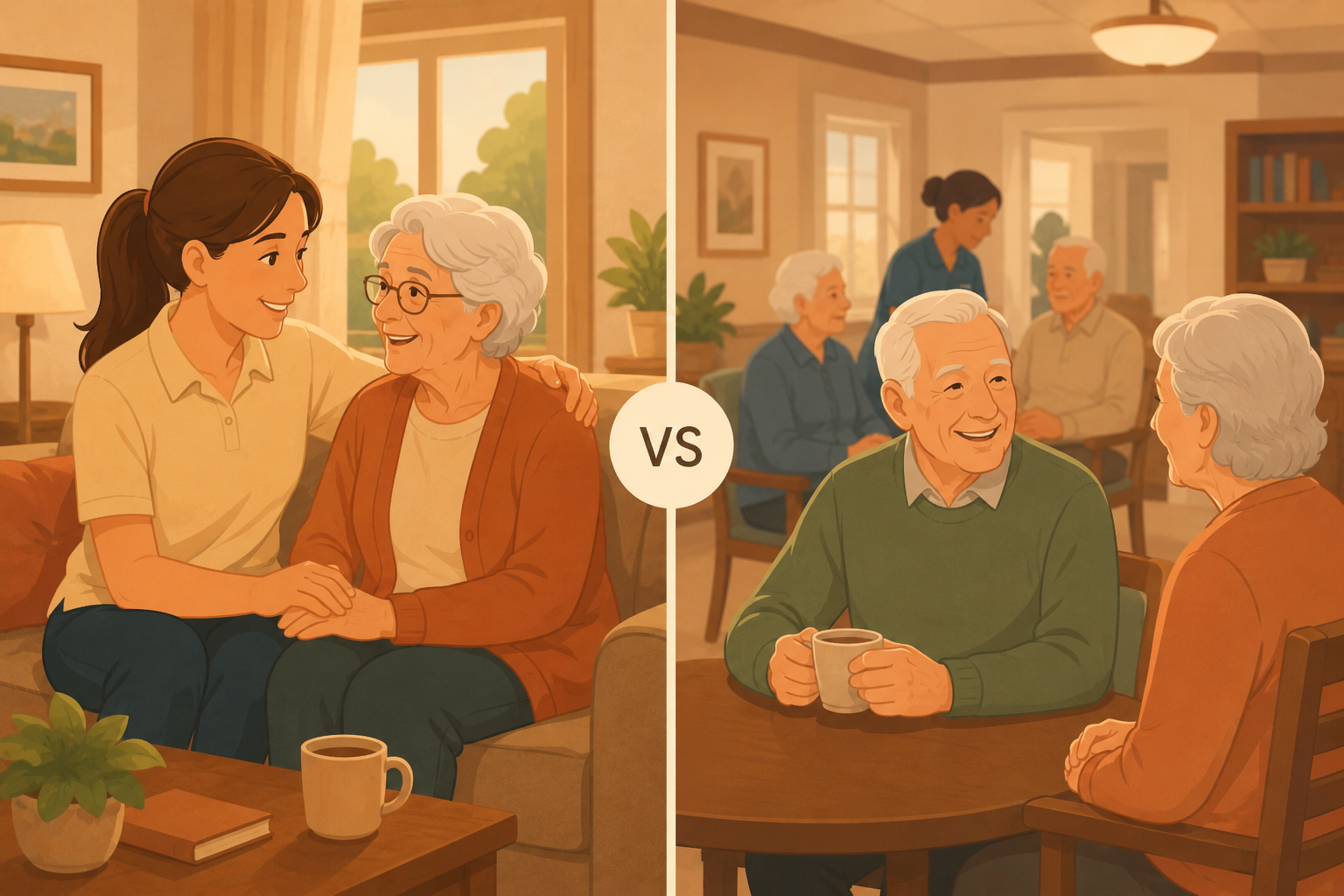
- Living assistance is care that comes to your loved one in their own home, very similar to in home senior care.
- Assisted living is a facility your loved one moves into. Same care goals, very different settings, very different price tags, and very different day-to-day experiences.
This guide is the one we wish more families had before they made the decision. We'll walk through what living assistance actually covers, what assisted living really looks like behind the brochure photos, what each one costs in 2026, when each makes sense, and how to make the call without second-guessing yourself for the next six months.
What This Guide Covers
- What Living Assistance Actually Is
- Living Assistance vs. Assisted Living at a Glance
- What Living Assistance Actually Includes
- What Assisted Living Actually Looks Like Day to Day
- The Real Cost of Each in 2026
- When Living Assistance Is the Better Choice
- When Assisted Living Makes More Sense
- Can You Combine Both?
- A Simple Framework for Making the Decision
- Common Myths About Living Assistance
- Frequently Asked Questions
What Living Assistance Actually Is
Living assistance is a category of senior care, sometimes called in-home care or non-medical home care, where a trained caregiver comes to your loved one's house and helps with the things that have gotten harder. Bathing. Cooking. Getting dressed. Going to doctor appointments. Staying safe at night.
It's the kind of care that makes aging in place actually possible. The vast majority of seniors say they'd rather stay in their own home as long as they can, and living assistance is the bridge that lets that happen. It can be a few hours a day, a few hours a week, overnight only, around the clock, or a live-in caregiver. The schedule flexes to fit the life your loved one already has.
One thing living assistance is not is medical care. If your parent needs skilled nursing, IV therapy, wound care, or physical therapy, that's home health care, and it usually comes through a different agency under a doctor's order. Most families need living assistance, not home health, for ongoing daily support.
Living Assistance vs. Assisted Living at a Glance
Before we go deep on either one, here's the side-by-side. This table gets at the differences that actually matter when you're making the choice.
| What Matters | Living Assistance (In-Home) | Assisted Living (Facility) |
|---|---|---|
| Where care happens | Your loved one's own home | A residential community, apartment-style |
| Who provides care | One or two consistent caregivers | Rotating staff across shifts |
| Daily routine | Built around your loved one's preferences | Built around the facility's schedule |
| Meals | Cooked at home, to personal taste | Communal dining, set menus and times |
| Personalization | Very high | Moderate, limited by staff ratios |
| Social life | Family, friends, neighbors, community visits | Built-in community of other residents |
| Pets | Stay home with your loved one | Pet rules vary, often restricted |
| Independence | Maintains routines and home environment | Apartment-style independence within facility |
| Typical starting cost (2026) | $32 to $42 per hour, or about $4,800/month for 40 hours/week | $5,000 to $7,500 per month for the base rate |
| Best for | Seniors who want to age in place with one-on-one support | Seniors ready for a community setting with social activity |
What Living Assistance Actually Includes
The phrase "in-home care" is so general it doesn't really tell you anything. Here's what living assistance actually covers in most homes, broken into categories so you can see whether it fits what your family needs.
Personal care (ADLs)
These are the activities of daily living that get harder with age, mobility issues, or recovery from surgery. Bathing and showering. Dressing. Grooming, including hair and shaving. Toileting and incontinence care. Transfers in and out of bed or a chair. Walking assistance.
Companion care
This is the kind of care that addresses loneliness, isolation, and the slow decline that happens when nobody's checking in. Conversation. Reading together. Playing cards. Watching the game. Going for walks. Trips to favorite restaurants or the grocery store. For many seniors, companion care is the most life-giving part of having a caregiver around.
Meal preparation and nutrition
Caregivers can plan meals, grocery shop, cook to your loved one's tastes and dietary needs, sit and eat together, and clean up. For families managing diabetes, heart conditions, or swallowing issues, having a caregiver who actually knows the diet is a huge load off.
Medication reminders
Caregivers aren't allowed to administer medication in most states, but they can absolutely remind, hand off the pill bottle, observe whether it was taken, and flag any concerns to the family or the agency's nurse.
Light housekeeping
Laundry, dishes, making the bed, vacuuming, tidying. The everyday stuff that turns into a fall hazard when nobody's keeping up with it.
Transportation
Doctor appointments. The pharmacy. Hair appointments. Church on Sunday. The senior center on Tuesday. Caregivers can drive your loved one in their car (or sometimes the caregiver's car), and a lot of families find this is the service they didn't know they needed most.
Dementia and Alzheimer's care
Trained caregivers who specialize in dementia know how to redirect during sundowning, how to handle repeated questions without frustration, how to maintain safety during wandering, and how to keep routines stable, which matters enormously for cognitive wellbeing.
Post-hospital recovery
When your parent comes home from the hospital after a surgery or a fall, the first two weeks are when readmission risk is highest. Living assistance during this window can mean the difference between a clean recovery and a second hospital stay.
Respite care for family caregivers
If you're the daughter who's been driving over every day for two years, a caregiver coming in for 8 hours a week so you can sleep, see friends, or just sit in silence isn't a luxury. It's the thing that keeps you healthy enough to keep showing up.
Overnight, 24/7, and live-in care
Living assistance flexes. A caregiver can stay overnight while your loved one sleeps, rotate in shifts for around-the-clock coverage, or live in the home full time with built-in rest hours.
What Assisted Living Actually Looks Like Day to Day
Assisted living gets pitched in glossy brochures with pictures of seniors in matching sweaters laughing at watercolor class. The reality is more nuanced, and worth understanding before you tour.
A typical assisted living community is a residential building with apartment-style units. Residents have their own one-bedroom or studio, usually with a small kitchenette, a private bathroom, and their own furniture. Common areas include a dining room, activity space, library, sometimes a salon, sometimes a small theater. Many have outdoor courtyards.
Most communities serve three meals a day in a central dining room at set times. Activities run on a posted schedule, things like exercise classes, bridge games, movie nights, religious services, and outings to local shopping or restaurants. Care staff are on site around the clock and provide help with daily activities based on a care plan written when your loved one moves in.
READ: Assisted Living Costs Versus In Home Care
What assisted living usually doesn't include is skilled medical care. If your parent develops needs beyond personal care, like daily injections, complex wound care, or feeding tubes, most assisted living communities will tell you it's time to consider a nursing home or memory care facility.
The care model is what catches families off guard. Most assisted living staffing ratios are one caregiver per 10 to 15 residents on day shifts and one per 20 to 30 residents at night. That means when your mom presses her call button at 3 a.m., she may wait. It also means the same caregiver who helped her shower yesterday may not be the one helping her tomorrow.
The Real Cost of Each in 2026
This is where families get the biggest sticker shock, in both directions. Here's an honest breakdown of what both options run nationally in 2026.
| Care Type | Typical 2026 Cost | What's Included | What's Usually Extra |
|---|---|---|---|
| Living Assistance (hourly) | $32 to $42 per hour | Caregiver time, agency oversight, scheduling, backup coverage | Holiday rates, mileage on long trips |
| Living Assistance (40 hrs/week) | $4,800 to $6,500 per month | Same as above | Same as above |
| Living Assistance (live-in) | $350 to $475 per day, or about $10,500 to $14,250 per month | Caregiver lives in the home with sleep and break time built in | Food for the caregiver, second caregiver for days off |
| Living Assistance (24/7 hourly) | $700 to $900 per day, or about $21,000 to $27,000 per month | Two or three caregivers rotating, awake the entire time | Holiday rates |
| Assisted Living (base) | $5,000 to $7,500 per month | Apartment, meals, basic activities, some help with daily activities | Higher levels of care, medication management, special diets, second person in unit |
| Assisted Living (with care add-ons) | $7,000 to $10,500 per month | Above, plus tiered care services based on assessment | Memory care, hospice add-ons, private duty aides |
| Memory Care (facility) | $7,500 to $11,000 per month | Specialized dementia care in a secure unit | Hospice services |
The math people don't always do is this. Living assistance is cheaper than assisted living if your loved one needs less than about 8 to 10 hours a day. Once needs cross the 24-hour threshold, assisted living usually wins on price, sometimes by a lot. The sweet spot for a living assistant is anywhere from 4 to 12 hours of care a day, which describes most seniors.
And keep in mind, the assisted living monthly figure doesn't include moving costs, deposits, or the emotional cost of leaving home, which is real even if it doesn't show up on the invoice.
When Living Assistance Is the Better Choice
Living assistance tends to be the right call when one or more of these is true.
- Your loved one is clear they don't want to leave home. This matters more than people think. Seniors who are moved against their preferences often decline faster.
- The home is safe, or can be made safe with reasonable modifications. Grab bars, a stairlift, a shower seat, removed throw rugs. Most homes can be adapted.
- Care needs are part-time or moderate. Anywhere from a few hours a week to around 12 hours a day is a sweet spot.
- There's a strong preference for one-on-one care. A consistent caregiver who knows your dad's stories beats a rotating facility staff for most personalities.
- Pets are part of the family. Most facilities have pet restrictions. Home is home for the dog too.
- Recovery from a hospital stay or surgery. Short-term living assistance during recovery is often the best money you'll ever spend.
- Early to mid-stage dementia in a familiar home. Familiarity is therapeutic for people with cognitive decline. Moving them often accelerates confusion.
- You want to preserve home equity. Keeping the house is often part of a longer financial plan, and living assistance lets you do that.
When Assisted Living Makes More Sense
Assisted living is the right answer too, sometimes. It tends to be the better fit when one or more of these apply.
- Loneliness is the main issue. If your loved one is starved for community and would thrive around peers, the built-in social life of a good facility can be genuinely life-changing.
- The home is unsafe and not realistic to modify. Steep stairs without room for a lift, a remote location far from emergency response, or a home that's no longer maintainable.
- Care needs are constant and continue to grow. Once around-the-clock care is needed permanently, assisted living often becomes cost-competitive or cheaper than 24/7 living assistance.
- The family caregiver is burned out or far away. If you're the daughter trying to do it from Charlotte and there's nobody close by, a facility offers continuity in a way that even great home care can struggle to match.
- Your loved one chooses it. Some seniors are genuinely ready and excited to move. Don't talk them out of it just because you read an article about aging in place.
Can You Combine Both?
Yes, and lots of families do. Here are the most common combinations we see.
Living assistance during a recovery, then back to independence. Mom has a hip replacement, gets 8 weeks of in-home care, and goes back to her normal life with weekly check-ins.
Living assistance leading into assisted living. A family uses in-home care for two or three years while they tour facilities, get on waitlists, and let Mom adjust to the idea on her own timeline. When the transition happens, it's planned and dignified, not a crisis move.
Private caregivers inside an assisted living facility. Many families hire a living assistance caregiver to supplement what the facility provides, especially during evenings, sundowning hours, or hospital stays. The facility doesn't have to be everything to everyone if you have private support layered in.
Hospice plus home or facility. Hospice care is its own thing, and it can happen at home alongside living assistance, or inside an assisted living or memory care facility.
A Framework for Making the Decision
If you're stuck, work through these in order with your family. We've watched a lot of families overcomplicate this, and the truth is most of the answer is already in front of you.
- Ask your loved one what they want. Out loud. With time to actually answer. Their preference should weigh heavily unless safety or capacity is a real issue.
- Get a clear-eyed assessment of care needs. A geriatric care manager, the primary care doctor, or a quality home care agency can do this. Don't guess.
- Take an honest look at the home. Stairs, bathrooms, kitchen, neighborhood safety. What needs to change to make aging in place work?
- Calculate the real budget, including future increases. Care needs grow. Build in a 10 to 15 percent annual increase to your projections.
- Tour two or three assisted living communities, even if you think you're leaning toward home. Walk through at different times. Eat a meal. Talk to residents, not just the marketing director.
- Try living assistance with a few weeks of part-time care. It's a low-risk way to see how your loved one responds.
- Pick the option you can revisit. Living assistance is easier to start, stop, or scale than facility care. That flexibility is worth a lot, especially while things are still in motion.
Common Myths About Living Assistance
A few things people believe about in-home care that aren't actually true.
Myth: It's only for people who can't live alone anymore. Plenty of clients use living assistance for a few hours a week to maintain independence, not because they can't function. Companionship and a couple of well-cooked meals a week prevent the decline that lands people in facilities.
Myth: Medicare pays for it. Traditional Medicare does not cover ongoing non-medical in-home care. It covers short-term home health after a qualifying hospital stay. Living assistance is usually paid privately, through long-term care insurance, VA benefits, or Medicaid waivers.
Myth: It's only for the wealthy. Even modest part-time care can transform a senior's quality of life and is often cheaper than people expect. Combined with a long-term care policy, VA benefits, or Medicaid waivers, it's accessible to a lot more families than the marketing implies.
Myth: Strangers in the home is too uncomfortable. A good agency takes the matching process seriously. The right caregiver becomes part of the family, and we mean that. We've watched caregivers cry at clients' funerals because the relationship was that real.
Myth: It's a last resort. Living assistance works best when it starts early. Waiting until there's a crisis makes everything harder and more expensive.
Frequently Asked Questions
What's the difference between living assistance and assisted living?
Living assistance is in-home care, where a caregiver comes to your loved one's house to help with daily living. Assisted living is a residential community your loved one moves into, where care is provided by on-site staff. Same general care goals, very different settings, very different costs, and very different daily experience.
Is living assistance cheaper than assisted living?
It depends on how many hours of care are needed. If your loved one needs less than about 8 to 10 hours of care a day, living assistance is usually cheaper. Once needs cross into 24-hour care, assisted living often becomes more affordable. The sweet spot for living assistance is part-time to moderate care, which fits the needs of most seniors.
What does living assistance include?
Living assistance covers personal care like bathing and dressing, companionship, meal preparation, medication reminders, light housekeeping, transportation to appointments, dementia care, post-hospital recovery, respite for family caregivers, and overnight or live-in care. It does not include skilled medical services like wound care or IV therapy, which fall under home health care.
Does Medicare cover living assistance?
No, not for ongoing non-medical care. Traditional Medicare covers short-term home health services after a qualifying hospital stay, but it does not pay for the day-to-day in-home support that most families need. Living assistance is typically paid through private funds, long-term care insurance, VA Aid & Attendance benefits, or state Medicaid waivers.
Can my parent get living assistance while in assisted living?
Yes, and families do this often. Hiring a private caregiver inside an assisted living facility is a good way to fill gaps, especially during the evening, overnight, sundowning hours for dementia residents, or stays in the on-site nursing unit. Most facilities allow this, though some require approval and may have rules around it.
How many hours of living assistance is typical to start with?
Most families start with 12 to 20 hours a week, often 3 to 5 days a week for 4-hour shifts. As needs grow, hours can scale up to overnight care, 24/7 coverage, or live-in care. Starting small lets your loved one adjust and gives you a chance to see what works before committing to more.
Is in-home care safer than assisted living?
It depends on the situation, but research consistently shows that seniors who receive one-on-one in-home care have better health outcomes than those in facility care, especially for people with dementia. The familiar environment, consistent caregiver, and personalized routine all contribute. That said, a home that's unsafe and can't be modified can absolutely be more dangerous than a well-run facility.
What if my parent refuses both options?
This is more common than you'd think. Start with the smallest possible intervention. A few hours of "help around the house" is easier to accept than "a caregiver." Sometimes the right entry point is light housekeeping or transportation, not personal care. As trust builds, the scope can grow. Pushing too hard up front usually backfires.
How do I find a quality living assistance provider?
Look for a licensed home care agency in your state that employs its caregivers as W-2 employees rather than 1099 contractors, runs criminal background checks and drug screens, carries general liability and workers' compensation insurance, conducts an in-home assessment before starting care, and has a nurse or care manager overseeing the care plan. Ask for references from current client families in your area.
What if my loved one's needs change?
Good living assistance is built for that. Care plans should be reviewed at least every 60 days and any time something changes. As needs grow, hours, services, and shift patterns can all adjust. If needs eventually outgrow what in-home care can provide, a quality agency will tell you honestly and help you think through the next step.
Ready to Talk Through Your Options?
Choosing between living assistance and assisted living is one of the bigger family decisions you'll make. There's no universally right answer, only the right answer for your loved one, your family, and where you are in this season of life.
If you want to talk it through with people who do this every day, we'd be glad to help. 4 Seasons Home Care has walked alongside hundreds of families at this exact crossroads. We'll listen, answer questions honestly, and tell you the truth even if home care isn't the right fit. Reach out anytime for a real conversation today.