

Compression Fractures in Seniors: Recovery, Prognosis, and Care at Home
Your mother bent down to pick up a laundry basket, or coughed hard, or sat down on the couch a little too quickly. Now she can't stand up straight, the pain in her back is sharp enough to take her breath away, and an X-ray has come back showing a compression fracture.
If you've spent the last hour searching, you've probably run into two frustrating things. Almost nobody explains what the next twelve weeks actually look like. And when families search whether this shortens a parent's life, most pages either dodge the question or offer a reassurance that isn't quite true.
We're going to answer both, and then get to the part that matters most day to day: what it takes to keep someone safe and comfortable at home while a spine heals. And also, how 4 Seasons Home Care can help with post hospital recovery for seniors in Atlanta.
- What a compression fracture actually is
- Signs families miss
- Prognosis: the honest answer about life expectancy
- The recovery timeline, week by week
- Treatment options, including kyphoplasty
- What gets hard at home, and what helps
- Movement precautions and the log roll
- Pain control in an older adult
- Preventing the next fracture
- Atlanta resources
- What home care covers during recovery
- Frequently asked questions
What a compression fracture actually is
A vertebra is a block of bone. When osteoporosis thins that bone enough, the front of the block can collapse under ordinary load, the way a cardboard box gives way when it gets damp. That collapse is a vertebral compression fracture.
The part that surprises families most is how little force it takes. There's often no fall at all. Lifting a grandchild, reaching into the trunk of a car, a hard sneeze, or simply standing up from a chair can be enough. When a bone breaks under a load it should have handled, doctors call it a fragility fracture, and it's a signal about bone health rather than about clumsiness.
Roughly 750,000 of these happen in the United States every year, and by most estimates about two thirds are never diagnosed. People assume the back pain is arthritis or a pulled muscle, it slowly fades, and the fracture is only discovered years later on an X-ray taken for something else. That matters, because each undiagnosed fracture is a missed chance to prevent the next one.
Signs families miss
- Sudden back pain that's better lying down and worse standing. This is the classic pattern. Pain that eases when she's flat and spikes when she stands or walks points toward bone, not muscle.
- Height loss. Losing more than an inch and a half from peak adult height is a red flag, and multiple fractures can take several inches.
- A new forward curve in the upper back. The stooped posture people call a dowager's hump is stacked vertebral collapse.
- Clothes fitting differently. Waistbands getting tight when weight hasn't changed happens because the torso is shortening and the ribs are settling toward the pelvis.
- Getting winded more easily, or eating less. As the spine curves, the chest and abdomen have less room. Both are commonly mistaken for general aging.
- Pain that came on with no injury anyone can name. The absence of a fall does not rule this out.
Prognosis: the honest answer about life expectancy
Most pages you'll find on this tell you a compression fracture doesn't affect life expectancy. The research doesn't support that, and we'd rather give you the real picture than a comfortable one.
A 2023 study in Aging Clinical and Experimental Research (Gutiérrez-González, Royuela and Zamarron) followed 492 patients aged 65 and older with acute compression fractures. Survival looked like this:
| Time after fracture | Survival |
|---|---|
| 1 month | 97.4% |
| 12 months | 86.6% |
| 24 months | 78.0% |
| 48 months | 64.4% |
| 60 months | 59.4% |
Overall mortality across the study period was 36.2%. The American Academy of Family Physicians has reported that women with a vertebral compression fracture carry roughly a 15% higher mortality rate than women without one.
Now the part that changes how you should read those numbers.
Here's why that distinction is practical rather than academic. If the fracture were the cause, there'd be little to do but wait. Because it's a marker, the things that actually move the numbers are the things you can influence starting this week: keeping her moving so she doesn't decondition, protecting her from pneumonia and infection, treating the osteoporosis underneath, preventing the next fall, and making sure she keeps eating.
Age matters too. A fracture in a 90 year old with three other conditions is a different situation from the same fracture in an active 68 year old, and the survival averages above blend both. What we tell families is this: the fracture is a warning worth taking seriously, and it's also the moment when good support changes the trajectory more than at almost any other point.
The recovery timeline, week by week
Most osteoporotic compression fractures heal without surgery. Bone healing typically takes about eight to twelve weeks, and the acute pain usually improves substantially over six to twelve weeks. Here's the shape of it.
| Phase | What's happening | What she needs |
|---|---|---|
| Week 1 to 2 Acute |
Sharp pain with any position change. Getting in and out of bed is the hardest thing in the day. Highest risk of a second fall. | Hands-on help with nearly everything. Someone present for transfers. Scheduled pain medication rather than waiting for pain to spike. |
| Week 3 to 6 Early healing |
Pain shifts from sharp to aching. She can be up longer. This is when families relax too early and someone gets hurt. | Short frequent walks, brace if prescribed, help with bathing and lower body dressing, close attention to constipation and appetite. |
| Week 6 to 12 Consolidation |
Bone is knitting. Endurance is still poor from weeks of reduced activity. Physical therapy usually ramps up here. | Support for the PT home program, gradual return to household tasks, continued help with anything requiring bending or lifting. |
| Month 3 and beyond Rebuilding |
Most acute pain has resolved. Some people are left with chronic back pain or permanent posture change. | Ongoing balance and strength work, osteoporosis treatment, home safety changes made permanent. |
For someone over 80, add time to every phase and expect the deconditioning to be the harder problem. Two weeks of mostly sitting costs an older adult a meaningful amount of muscle, and rebuilding it takes far longer than losing it did. That's the single biggest argument for getting help in the house early rather than waiting to see how it goes.
Treatment options, including kyphoplasty
Conservative care is the starting point for most patients: pain control, a short period of relative rest (not extended bed rest, which causes its own problems), activity modification, sometimes a brace, and physical therapy once the acute phase passes.
Bracing ranges from a simple elastic binder to a rigid TLSO. Braces limit painful motion and can help someone stay upright and moving, but compliance is genuinely difficult. They're hot, they're awkward to put on alone, and many older adults quietly stop wearing them. If a brace is prescribed, someone needs to be there in the morning to fit it properly.
Kyphoplasty and vertebroplasty are minimally invasive procedures where bone cement is injected into the collapsed vertebra. Kyphoplasty first inflates a small balloon to create a cavity and restore some height, then fills it. Vertebroplasty injects cement directly. They're generally considered for patients whose pain isn't controlled with conservative care.
One caveat to raise with the surgeon rather than skip: the evidence on these procedures has been debated, with some sham-controlled trials finding less benefit than earlier studies suggested. Guidelines have shifted over the years. It's a reasonable option for the right patient and a fair question to ask directly.
What gets hard at home, and what helps
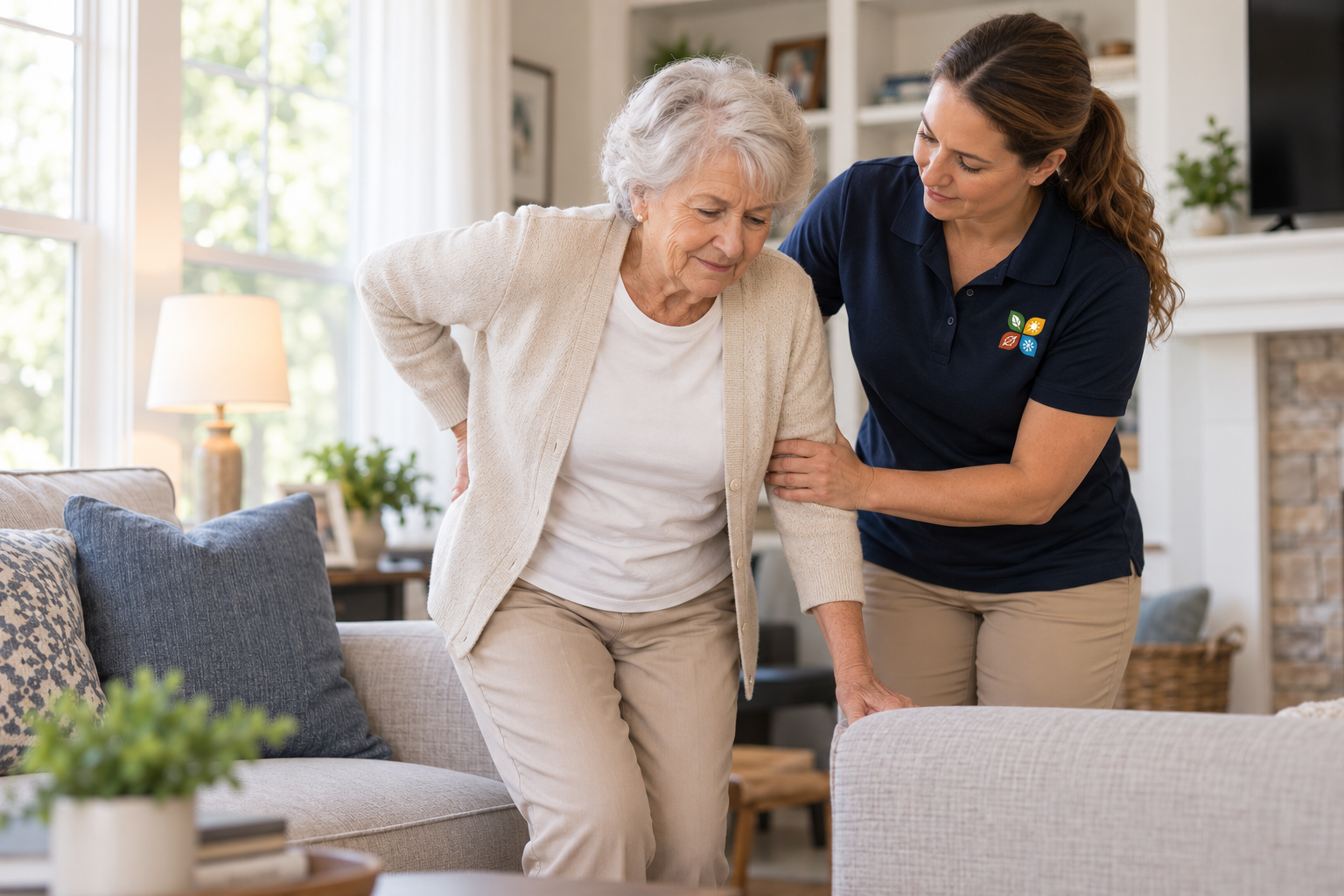
This is the section most articles skip, and it's the one families actually need. A compression fracture doesn't take away walking. It takes away bending, reaching, twisting, and lifting, which turns out to be most of daily life.
| Task | Why it's hard now | What helps |
|---|---|---|
| Getting out of bed | Sitting straight up loads the fracture directly and is often the worst pain of the day | Log roll technique, bed rail, raising the bed height |
| Socks, shoes, lower body dressing | Requires exactly the forward bend she must avoid | Long-handled shoehorn, sock aid, reacher, or hands-on help |
| Bathing | Stepping over a tub wall, bending to wash feet, twisting to reach the back | Shower chair, handheld sprayer, grab bars, long-handled sponge, standby or hands-on assistance |
| Toileting | Lowering and rising loads the spine, and constipation from pain medication makes straining worse | Raised toilet seat with arms, a bowel regimen started the same day opioids start |
| Laundry and groceries | Both exceed typical lifting limits | Someone else does them, full stop |
| Cooking | Reaching low cabinets, lifting pots, standing at a counter | Move daily items to waist height, prepared meals, help with meal prep |
| Sleeping | Rolling over wakes her, flat surfaces hurt | Pillow between the knees side-lying, or under the knees on the back |
| Driving | Twisting to check blind spots, plus sedating medication | Not until cleared, and arrange rides in advance |
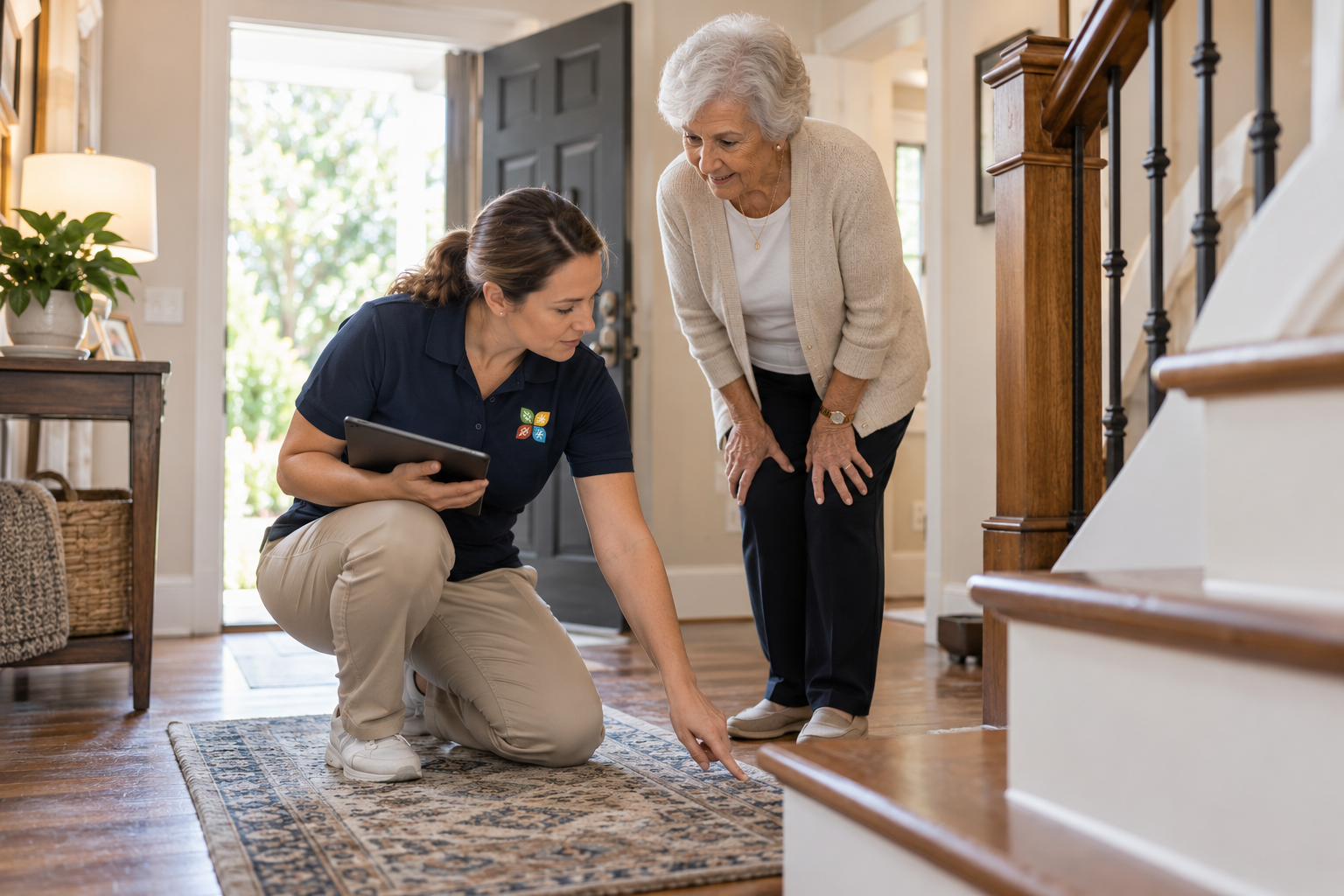
Occupational therapy can bring most of this equipment and teach the techniques, and it's worth asking for a referral. In the meantime, the practical answer to nearly every row above is that someone needs to be in the house. Our home safety assessment walks the same checkpoints we use when we set up a recovery case, and choosing the right mobility aid covers walkers and canes in more detail.
Movement precautions and the log roll
Most surgeons and therapists give some version of the same three rules while the fracture heals: no bending, no lifting, no twisting. Practically, that usually means no forward bending at the waist, a lifting limit often set around five to ten pounds (a gallon of milk is about eight), and turning the whole body rather than twisting the trunk.
The log roll is the single most useful thing to teach a family member, because getting out of bed is where the pain and the risk concentrate:
- Lying on her back, bend both knees so the feet are flat.
- Roll the shoulders, hips, and knees together as one unit toward the edge of the bed, keeping the spine in a straight line.
- Let the lower legs drop off the edge while pushing up sideways with the arms.
- Come to sitting using the arms, not the abdominal muscles, and pause before standing.
Reverse it to get back in. It feels awkward for about two days and then becomes automatic.
Pain control in an older adult
Undertreated pain keeps someone in bed, and bed rest is what causes the pneumonia, the blood clots, and the muscle loss that actually threaten an older adult. Pain control isn't a comfort issue here, it's a safety issue. At the same time, the medications carry real risk in this age group.
- Acetaminophen is usually the backbone, with attention to the daily ceiling and to whether it's hiding in other combination products.
- NSAIDs like ibuprofen and naproxen carry stomach, kidney, and cardiac risk in older adults and interact with blood thinners. Many seniors shouldn't take them at all.
- Opioids may be necessary early. They also bring constipation, sedation, confusion, and a sharply increased fall risk. If one is prescribed, a bowel regimen should start the same day, and someone should be present for the first several days.
- Muscle relaxants are frequently prescribed and frequently a problem in this population because of sedation and falls. Worth questioning specifically.
Scheduled dosing during the acute phase generally works better than waiting for pain to become severe. Our guide to what caregivers can and can't do with medications explains where the line sits in Georgia, and helping a senior sleep better at night covers positioning when pain is disrupting rest.
Preventing the next fracture
Perhaps the most important point here: one vertebral compression fracture substantially raises the risk of another, and the risk is highest in the first year. Fractures also tend to cascade, with each collapse shifting load onto the vertebrae above and below.
And yet the majority of older adults who sustain a fragility fracture are never evaluated or treated for the osteoporosis that caused it. The fracture gets treated. The bone disease doesn't. This is a well documented gap in care, and it's one families can close by asking directly.
- A DEXA bone density scan, if she hasn't had one recently.
- Bloodwork to check vitamin D and calcium, and to rule out other causes of bone loss.
- A specific answer on osteoporosis medication. A fracture usually means the answer is yes, and options include bisphosphonates, denosumab, and bone-building drugs like teriparatide.
Then close the loop on falls. Our 50 fall prevention tips and guide to preventing senior falls cover the home changes, and seasonal fall risks is worth a read heading into winter. In Georgia, falls were the leading cause of unintentional injury death among adults 65 and older as of 2020.
Atlanta resources
Spine and orthopedic care. Emory Spine Center (404-778-3350) has nine metro locations including Dunwoody, Johns Creek, Smyrna, Decatur, Tucker, and Brookhaven, and treats compression fractures both surgically and nonsurgically. Resurgens Orthopaedics (404-847-9999) has more than 30 metro locations, which usually means a shorter drive for someone who can't sit in a car comfortably.
Bone density and osteoporosis. Piedmont's Osteoporosis and Bone Health Center offers on-site X-ray, on-site DEXA, and an infusion suite, and treats post-fracture patients. Northside Hospital's bone densitometry program describes the DEXA scan as roughly 45 minutes, with no injection, no prep, and radiation less than a tenth of a single-view chest X-ray. Worth knowing if your parent is anxious about the test.
Inpatient rehab, if she isn't safe to go straight home: Emory Rehabilitation Hospital on Clifton Road (404-712-5512) is CARF accredited, and the Rehabilitation Hospital of Atlanta, a 40-bed Encompass Health and Piedmont facility, opened in 2024.
Home modification and equipment help. This is the resource most families never hear about. empowerline, the Atlanta Regional Commission's Area Agency on Aging, is reachable at 404-463-3333, Monday through Friday, 8am to 5pm, and serves the City of Atlanta plus Cherokee, Clayton, Cobb, DeKalb, Douglas, Fayette, Fulton, Gwinnett, Henry, and Rockdale counties. Georgia's Division of Aging Services (866-552-4464) lists home modification, repair, and assistive technology among its home and community based services for adults 60 and older.
After a car accident. If the compression fracture or back pain followed a car accident, AICA Orthopedics (404-855-2141) specializes in treating car accident-related orthopedic and spinal injuries across Metro Atlanta. AICA offers same-day appointments and has on-site X-rays and MRI, with orthopedic doctors, spine specialists, neurologists, physical therapists, and other providers working together under one practice. That can be especially helpful after a collision when an older adult may be dealing with more than one injury and needs imaging, diagnosis, and follow-up care coordinated in one place.
Home Care At Home & Caregivers. We serve families across Atlanta and Buckhead, Marietta, Dunwoody, Suwanee, and Stockbridge.
What home care covers during recovery
If she was hospitalized, Medicare-certified home health may send a nurse and a physical therapist for a limited number of visits. That's valuable and it's also intermittent. It doesn't cover the hours in between, which is where the actual risk sits: the 2am bathroom trip, the missed dose, the meal that didn't get eaten, the shower nobody was there to steady.
During a compression fracture recovery, that gap is usually filled with after hospital care, which is built for exactly this window, and personal care for the bathing, dressing, and toileting help the precautions require. Families often start with daytime coverage and taper as she gets stronger. When pain is worst at night or the bathroom trips are the concern, overnight care handles it, and for someone frail enough that being alone isn't safe at all, 24/7 and live-in care covers the first several weeks.
If you're the one doing all of this and you're already stretched, respite care exists so you don't become the second patient. If the situation is complicated enough that nobody can hold all the pieces, an Atlanta geriatric care manager can assess and coordinate it. And when you're ready to think past the acute phase, building a real care plan is the right next step. For what any of this costs locally, see senior care costs in Atlanta or start with in-home senior care.
Frequently asked questions
Does a compression fracture shorten life expectancy?
Research does show reduced survival after a vertebral compression fracture. One 2023 study of 492 patients aged 65 and older found survival of 86.6% at one year and 59.4% at five years, and the AAFP has reported roughly 15% higher mortality in women with a vertebral fracture. Most researchers view the fracture as a marker of underlying frailty and osteoporosis rather than a direct cause of death. In that same study the leading cause of death was infection, and there was no significant survival difference between surgical and conservative treatment.
How long does a compression fracture take to heal in an elderly person?
Bone healing usually takes about eight to twelve weeks, with the sharpest pain improving over the first six to twelve weeks. For someone over 80, expect each phase to take longer, and expect deconditioning from reduced activity to outlast the fracture pain itself.
Can a compression fracture heal on its own?
Yes. Most osteoporotic compression fractures heal without surgery, using pain control, activity modification, sometimes a brace, and physical therapy. What doesn't resolve on its own is the osteoporosis underneath, which is why treating the bone disease matters as much as treating the fracture.
Should a 90 year old have kyphoplasty?
Age alone doesn't rule it out, and it's a minimally invasive procedure. The real questions are whether pain is uncontrolled with conservative care, how much the pain is limiting movement (which carries its own risks in a very old adult), overall health and anesthesia tolerance, and timing. Emory advises that kyphoplasty is best done within eight weeks of the fracture for the best chance of restoring vertebral height, so it's worth asking early rather than waiting months.
What should you not do with a compression fracture?
Avoid bending forward at the waist, twisting the trunk, and lifting more than the limit your doctor sets, often around five to ten pounds. Also avoid extended bed rest. It feels protective and it isn't, because it accelerates muscle loss, pneumonia risk, and blood clots in older adults.
Can you walk with a compression fracture?
Usually yes, and walking is generally encouraged as tolerated once pain is controlled. Short frequent walks beat one long one. What's discouraged is bending, lifting, twisting, and lying in bed all day.
What happens if a compression fracture goes untreated?
The fracture itself often heals, but untreated osteoporosis leads to more fractures, and stacked collapse produces the forward curve that can reduce lung capacity, crowd the abdomen, suppress appetite, and cause chronic pain and loss of independence.
Will she get another one?
The risk of a second vertebral fracture rises substantially after the first, and it's highest during the first year. This is the strongest argument for a DEXA scan and a real conversation about osteoporosis medication, since most people who fracture never get evaluated for the bone disease that caused it.
How much help does someone need at home after a compression fracture?
In the first two weeks, most people need hands-on help with getting out of bed, bathing, dressing, and toileting, plus someone present for safety. Weeks three through six typically still need help with bathing and anything involving bending or lifting. Many families start with daytime coverage and taper, but the highest risk period is the one families most often try to cover alone.
Does Medicare cover care at home after a compression fracture?
Medicare may cover skilled home health, meaning intermittent nursing and therapy visits, if criteria are met. It generally doesn't cover the ongoing hourly personal care and supervision families are usually picturing. Those hours are typically private pay, long term care insurance, or VA benefits.
Recovering at home shouldn't mean recovering alone
The first six weeks after a compression fracture are when a family is most stretched and when the risk of a second injury is highest. We can usually get a caregiver in place quickly, including same week after a hospital discharge, and we'll help you figure out how many hours you actually need instead of selling you more.
Schedule a free consultation or call (678) 825-8335.
This article is general education and not medical advice. Compression fractures vary widely, and treatment decisions, movement restrictions, lifting limits, and medications should come from your parent's own physician and therapy team. If you notice leg weakness, numbness in the groin, loss of bladder or bowel control, or fever with back pain, seek emergency care.